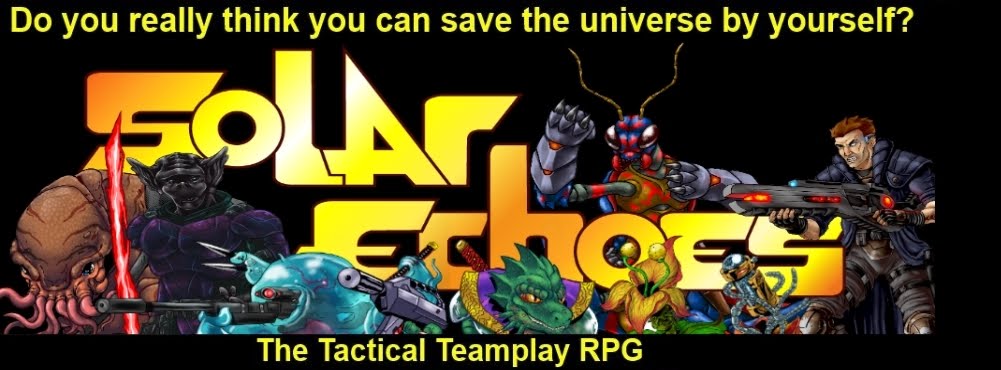
As seven alien races struggle to co-exist in an uneasy alliance, the Inter-Stellar Union sends Union Guard agents on missions to preserve the crucial balance. These specialized operatives must do what regional security cannot, dealing with smugglers, pirates, terrorists, and even greater challenges in order to bring stability to a universe that needs it desperately. Without the Union Guard, the races will not be prepared to face a looming alien threat they can only hope to defeat together.
Tuesday, September 10, 2019
GMing and VN Writing (part 2)

Monday, September 9, 2019
GMing and VN Writing (part 1)
I’ve played
table-top role-playing games for most of my life, and I usually
prefer to play as the Game Master (GM). For those of you who are
unfamiliar, the GM is responsible for narrating the story, acting out
the various characters the players will meet, and enforcing the rules
of the game. I’ll admit, I’m not a rules encyclopedia like some
other GM’s are, but I make sure the game is fair and I focus on
keeping the game more story and character focused. Combat is often a
part of RPG’s, and because I love strategy games, I definitely like
to mix tactical battles in where they fit naturally within the story.
One of the most important abilities a keep needs to possess is the
ability to creatively improvise when players decide to do something
unexpected. The experience and skills that come from GMing role
playing games can really help in other jobs, especially in video-game
development!
Friday, September 6, 2019
Tokyo Chronos VR Review (part 5)
I should also
mention that, from everything I've played so far and read online,
Tokyo Chronos is a “kinetic novel,” meaning that there are no
choices for you to make. I have yet to discern how the advertised
claim of multiple endings can be achieved without some choice being
presented, but after 3 hours so far, everything has been entirely
kinetic. For me, this was disappointing, because I prefer VN's with
choices to kinetic novels, but that is just my personal preference. I
did really like being immersed in the 3D world of Tokyo Chronos,
seeing the characters right in front of me--it really did feel like I
was a character in an anime. As for the story, I won't reveal
anything, but I will say that the tone is dark. The dialogue is
well-written, and aside from a few typos and grammatical mistakes, it
is effectively constructed and intriguing. The game was funded
through Kickstarter, so considering its origins, I think what has
been done is impressive. I do feel, however, that there were some
lost opportunities, so I hope that game developers are inspired by
Tokyo Chronos and decide to push the application of VR to visual
novels even further--it's a step deeper into immersive storytelling!

Thursday, September 5, 2019
Tokyo Chronos VR Review (part 4)
During the game,
there were some instances where I found myself placed in unusual
locations that I didn't expect, and this created more immersion for
me. For instance, at one scene change I was suddenly sitting inside a
car talking to someone else in the driver's seat. I liked that the
game framed the scene by positioning me at the best angle to observe
the events. Moments of action were highlighted in typical VN fashion
with the presentation of a static art image (known as a CG.) These
were often displayed as smaller, flat panel art, framed almost as if
they were taken right out of a comic book. This approach enhanced the
feeling of being inside a manga/anime world, and it was a nice touch.
The audio of the game was well put together, with a subtle soundtrack
that enhanced the mood, sometimes crescendoing to enhance the tension
or dropping out altogether to let silence weigh on my nerves. Sound
effects weren't distracting or overused, but served to augment each
appropriate moment. The overall presentation was very fitting for an
anime setting with a dark undertone.

Wednesday, September 4, 2019
Tokyo Chronos VR Review (part 3)
If you were
expecting live action anime in Tokyo Chronos, keep in mind that
visual novels (VN's) involve mostly static backgrounds and characters
with short animations, if any. If you're familiar with Live2D in some
VN's, the characters in Tokyo Chronos were animated similarly, with
blinking eyes, moving lips when speaking, and a few other small
movements here and there. Each character had a good range of body
poses and facial expressions, which helped amplify the impact of the
dialogue. The dialogue was nicely voice acted and fit each character
well, but it was all only in Japanese. Reading the printed dialogue
is a must for those unfamiliar with spoken Japanese, though this of
course won't be unusual for anime fans. The text is clearly printed
inside your sight range, wherever you look. There is even an option
to fix the text to a horizontal level so it doesn't stay in your
vision if you look up or down. No worries for those of you with VR
motion sickness, because you cannot move in Tokyo Chronos. The story
places your character in every scene, positioning you to stand, talk,
and observe everything around you, taking in the atmosphere as the
story unfolds.

Tuesday, September 3, 2019
Tokyo Chronos VR Review (part 2)
When I started
Tokyo Chronos on PSVR, I used the Move controllers because the game
was advertised as having that option. Other than using them
essentially as laser pointers during menu selection, though, the
controllers were otherwise not utilized beyond simple button
pressing. I had hoped to be able to see my arms and hands move at
least, but I existed in the game as an armless torso--I could look down at myself and see the school uniform my
character was wearing. Another thing I noticed right at the beginning
of the game was that the scale was off, regardless of the height
adjustment option. Perhaps this was intentional, but it felt weird
being a 10 foot giant among other 10 foot tall characters, in a world
where everything felt larger than it should be. Everything was
proportionately scaled within the game environment, but my own sense
of scale from my reality was definitely different. However, the art
in Tokyo Chronos is all done in a very anime style, so realism is not
something to expect. I enjoyed feeling like I was a character in an
anime world, and at several points in the game, I actually could see
what my character looked like when standing in front of a mirror. The
art style had a cel-shaded feel with a color palette that was an odd
mix between characters and environment, but the overall tone was
consistent.

Monday, September 2, 2019
Tokyo Chronos VR Review (part 1)
I recently
downloaded a new game for VR called Tokyo Chronos. This game is the one of the first of its kind--it's a visual novel in VR! As a visual novel
writer and developer myself, I was very excited to see this genre of
game enter virtual reality. This week, I'll share my impressions and
opinions about Tokyo Chronos, which is a monumental step for visual
novels. Although I am nowhere near finishing the game yet, I think
that the 5 chapters I have played so far are enough for me to give a
fair analysis. I'll focus on the game itself and not the story, to
avoid spoilers. A few things really excited and impressed me, and
other instances felt like opportunities lost. Is VR a good fit for
visual novels? I think it is, and Tokyo Chronos is a step in the
right direction for the genre.

Subscribe to:
Posts (Atom)