There is a lot more to writing
characters, but I'll quickly touch on a few other tips that will help
make your characters interesting. Does your character have a secret?
How would the character change if the secret became known, and how
far might that character be willing to go to keep the secret safe? Is
your character funny? If so, make sure that you can be funny, too, or
you may be writing a character so different from yourself that it
will be a burden to write. Does your character have an interesting
contrast, such as an impressive strength but a hidden fear? There is
a huge variety of character traits that you can play with and ascribe
to your characters, but a common mistake is assigning too many
unusual traits to a single character. Sometimes the most memorable
characters are those with only one or two traits that set them apart
from others, whether it is a habitually uttered word or a frequent,
stubborn insistence over something trivial. Keep in mind that some
characters will initially seem bland and uninteresting—often
different people strike us that way in real life—until you get to
know them!
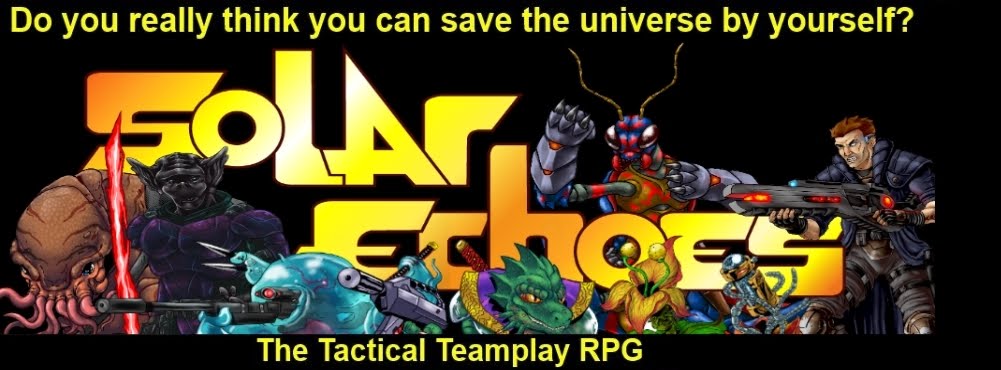
As seven alien races struggle to co-exist in an uneasy alliance, the Inter-Stellar Union sends Union Guard agents on missions to preserve the crucial balance. These specialized operatives must do what regional security cannot, dealing with smugglers, pirates, terrorists, and even greater challenges in order to bring stability to a universe that needs it desperately. Without the Union Guard, the races will not be prepared to face a looming alien threat they can only hope to defeat together.
Friday, June 29, 2018

Thursday, June 28, 2018
Writing Interesting Characters (part 4)
However, character background alone is
just a framework upon which to hang other determining factors. What
does the character enjoy? Is the character passionate about something
so much that she will fight for it regardless of what might happen to
others in the process? Or maybe that character isn't a fighter, but
she's still passionate about something so much that she'll find
everything else in life pointless and will wallow in depression
because her goal seems so out of reach? A third option is that the
character hasn't yet found anything to be passionate about, and she's
either actively searching to find it or is apathetic because she's
given up and doesn't think anything matters. Motivation is a huge
factor in most characters, but a character can still be intriguing if
motivation is completely lacking. Even the lack of motivation is a
trait that can develop an interesting character, especially if, at
some point in the story, that character encounters something that
flips on the light switch and gives them something to value.
Ultimately, characters need to have something underneath the hood, so
to speak, so that they aren't always responding predictably to the
events that you throw at them through your story.
Wednesday, June 27, 2018
Writing Interesting Characters (part 3)
Background definitely influences how a
character might develop, but even characters from the same background
can be entirely different. Another step to writing an interesting
character is deciding on how they reacted to their background
circumstances. Some people have a flight response, and others will
instead fight. For example, think about this potential scenario: 3
children are left as orphans when something tragic happens to their
parents. How each of those children responds to this tragedy might
depend on a variety of factors, such as their age, gender, and
whether they've had to fight for something before or if they're used
to relying on someone else to get what they want. One possible
example in this scenario: The oldest of the 3 feels the burden of
responsibility and takes charge as a leader for the other two. Would
the level of “tough love” and nurturing be different for someone
in this role than the other two? What if that character wasn't
naturally very good at nurturing, but with the other two relying on
him or her, it might suddenly become a very forced character trait
that produces a struggle and a transformation over time. Or perhaps
the character was able to keep up the facade for the others but was
quite the opposite internally, struggling to be free of the role
while feeling trapped.
Tuesday, June 26, 2018
Writing Interesting Characters (part 2)
One of the toughest things about
writing interesting characters is not writing yourself into all of
them. As an example, it's like some composers write music that all
starts to sound predictably familiar—there's not enough
differentiation because it blends and is too recognizable as that
composer. If you think your personality is interesting enough for
your story, then it's not necessarily a bad thing to write yourself
into one character, but be careful not to let all the other
characters become clones of yourself. How do you beat this tendency,
though? Sometimes, writers swing the pendulum to an extreme because
they're trying too hard to avoid writing themselves again. The
downside to this is that such extreme characters often feel contrived
or unrealistic—we can't identify with them because we've never met
a single person like that in our lives. Consider your own life and
how you live for a moment. Who are the people in your circles? How
often are you outside of your comfort zone? If there is someone you
know that you feel is extremely different, ask yourself what it is
that makes them so different? Did they grow up in another country,
state, or city? Were their life circumstances vastly different from
yours? Taking note of this is only the beginning to understanding
other people and how to write different characters, but it's a start.
Monday, June 25, 2018
Writing Interesting Characters (part 1)
Yes, I'm obviously a gamer, and from
the many Solar Echoes books I've released (and frequent social media
posts) you've probably also gathered that I'm an avid writer. In
addition to my hopes of becoming a novelist someday, I'd also be very
open to writing for video games—specifically RPG's. Video game
companies are hiring experienced writers to craft the stories for
their games, and RPG's have become a very popular genre. Their
success is due, in part, to the epic stories and interesting
characters that the game is based upon. Back in 2002 when the D&D
RPG game “Neverwinter Nights” released, I remember spending
untold amounts of time designing my own adventures. I enjoyed
designing the settings, the challenges, and even scripting (coding) a
few unique features, but the best part was writing the dialogue trees
for the characters. Writing conversation options and responses for
each character involved complex branching conversation trees,
assigning tags for choices that would open or close other dialogue
options. As I did all this, it also developed my own writing style,
because it got me thinking about how the personalities of each
character could be reflected in their choice of words and the
responses they would more likely give in each situation. I still
consider some of the same things when writing characters...
Friday, June 22, 2018
My VR Getaway (part 5)
Looking down at my feet during the
scary dream sequences didn't help much, though. At one point I knew
someone had approached me and was standing behind me—I could hear
him breathing. I slowly turned around and saw his feet as he was
standing there. He didn't move, but kept breathing. I carefully
raised my head and, as soon as I looked at his face—ARghghgh! Ok,
it freaked me out. I knew it was coming, but it still shocked me. It
never would have in a movie or a normal video game, but in VR, it was
horrifying and that physical chill instantly raced through my body
again. I knew it was a game, I knew that thing wasn't there in front
of me, but what you know intellectually is overridden by VR. My
little dog, sitting on the nearby couch, didn't help me handle the
experience well when he started scratching himself and I could hear
it. I thought someone had come into the room behind me! Well, I
played over an hour of the Inpatient before I had to give my nerves a
rest. I decided to switch games and play some Star Trek: Bridge Crew.
I enjoyed commanding and coordinating with my team and we
successfully completed our exploration mission, blowing up a few
Klingon ships in the process with confident satisfaction. It was a
nice way to clear my mind of the horrors I'd experienced in the
Inpatient. After all, I still had to walk upstairs into my dark,
unlit house, all alone at night!
Thursday, June 21, 2018
My VR Getaway (part 4)
The full-body avatar was realistic
enough, though the developers got the scale wrong a bit and I felt
like a 7 foot giant with hands and arms notably bigger than my own. I
was disappointed that there weren't any mirrors in the game I could
use to see myself and dance in front of. The Inpatient began with a
doctor asking me questions as I sat there with my arms strapped to
the chair. He seemed friendly enough, in that
patronizing-pscyhologist-at-a-mental-facility sort of way. One thing
that drew me into the game was the interactive response system: I
could answer his questions two ways, and even though I could select
my choice with my move-controllers, I also had the option to speak
them. I totally loved that—it gave me a chance to role-play and act
my character! Later, I was wheeled away by an orderly who seemed like
a nice guy, and was eventually brought food in my room by a nurse,
who told me to get some sleep. Once in a while I'd have the
opportunity to interact with different objects in my room. At one
point, I saw a cockroach on my table, so I picked up a nearby book
and squashed it. However, I began to have odd dream-like experiences
where things were...not right. I began to really dread these
occurrences, because I'll be honest, they were unsettling. As I had
more of these dreams over time, “reality” would get worse, too.
At one point in a dream sequence, I was asked to follow the orderly,
when suddenly he stopped and turned around with a horrific, distorted
face growling very close to mine. I literally felt a chill sweep down
my body from my head to my feet, like one of those sudden shivers you
get, but 10 times worse. Suffice it to say, I began looking down at
my feet while walking whenever I found myself in another twisted
dream sequence!

Subscribe to:
Posts (Atom)