Though some races can easily share
armor with others, other alien races have more extreme physical
differences than the bipedal races. Even the Humans and Reln
sometimes have their own specialized armors, though they can share
with each other, considering their physical similarities. The
plant-like Erwani--with their 4 vine-like arms, multiple roots (their
“legs”) and leafy body—use armor that is essentially plating
connected by cords, which drapes over the Erwani's thin shape. The
insectoid Chiraktis wears armor that is tailored for its shape, and
Chiraktis Battle Armor is famous for its thermal resistance.
Krissethi armor is entirely transparent, which allows the Krissethi
to fully utilize the camouflage capabilities afforded by the
chromatophores in their skin. Archaeloids often go without armor, as
their naturally hard shells serve as excellent protection for most of
their bodies. The amoeba-like Omul, however, can choose to fit into
the armor of just about any race, and can even walk around in
humanoid battle suits, though the constraints upon their mobility
sometimes cause Omuls to prefer going au naturel.
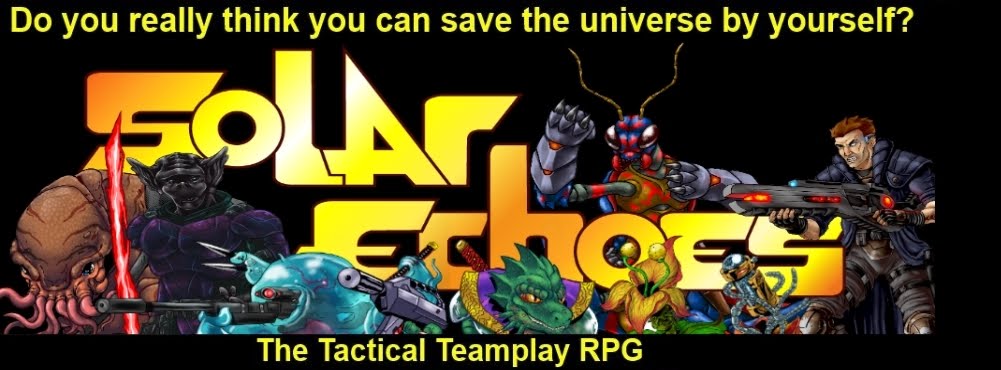
As seven alien races struggle to co-exist in an uneasy alliance, the Inter-Stellar Union sends Union Guard agents on missions to preserve the crucial balance. These specialized operatives must do what regional security cannot, dealing with smugglers, pirates, terrorists, and even greater challenges in order to bring stability to a universe that needs it desperately. Without the Union Guard, the races will not be prepared to face a looming alien threat they can only hope to defeat together.
Tuesday, June 10, 2014

Monday, June 9, 2014
How does armor work in Solar Echoes? (part 1)
In a large number of RPG's, armor
prevents your character from being hit altogether. The higher your
armor quality, the harder it is to injure you. However, in Solar
Echoes, we view armor differently. Armor is protection that reduces
damage if you are hit, but being hit is a function of whether you
dodged the attack or not. For instance, regardless of a character's
armor, an attack against the character must be better (more accurate)
than the character's dodge roll. If the attack is successful, the
damage is then first absorbed by the armor before penetrating to the
character. However, armor also has hardness, which depletes as it
absorbs damage. A standard suit of combat armor has 20 hardness, so
if an attack doing 4 ballistic damage hits a character with combat
armor (which protects against 2 damage), 2 damage will get through to
the character, while 2 is absorbed by the armor, reducing the armor
to 18 hardness from 20. Once the hardness of a suit of armor has been
depleted to 0, the armor no longer absorbs damage and all damage goes
straight through to the character.
Friday, June 6, 2014
Are You Being Watched? (part 5)
In Solar Echoes, you play as an agent
of the Union Guard, a special-ops force that works for the
Inter-Stellar Union (ISU.) The ISU was established to unify the races
and end the border wars that had plagued civilized space. When
running a game of Solar Echoes, it is up to the MC to decide just how
benign this government is, but as the players take on various
missions, they may begin to discover that the ISU is withholding
important information from the public, controlling the internet, and
might even be stoking racial and class tensions. As the races expand
across the galaxy, the further they are away from the core systems,
the harder they are to monitor, so it is no surprise that the ISU has
extended its reach with various forms of surveillance. Law and order
should be maintained, but when freedoms begin to erode in the name of
government protection and oversight, one must question how far is too
far? In the Solar Echoes universe, cyber-security has become so
advanced that single hackers can no longer hope to accomplish much on
their own. Groups of hackers, or even hackers with un-skilled
supporters on their team, can potentially bring down a system.
However, the internet architecture of the future has been carefully
compartmentalized to prevent massive hacks from shutting down
multiple, major systems. Though such a separation of systems makes
perfect sense, we have to wonder if our present day internet is
irrevocably constructed with far too much integration and reach. Have
we made it too easy for someone to influence, spy on, and dominate
us?
Thursday, June 5, 2014
Are You Being Watched? (part 4)
Do you think your emails are private?
Maybe your phone calls, or your texts? The NSA has archives of all
this data, and they can access any of it. Of course, this is archived
data and is unlikely to be perused unless the NSA decides you are a
person of interest. Just how can you earn such an honor? It really
depends on your internet habits and the combinations of words that
you use in your digital communications. Our government is spying on
us with PRISM, and a source for the Washington Post said, “They can
quite literally watch your ideas form as you type.” I guess I
should wave my hand to the government right now and say hello? With
all the online research we've done to make Solar Echoes a realistic
representation of our near future, it is likely that prying eyes have
taken an interest. I've always believed science-fiction is an
effective warning about the path we're headed down, and Solar Echoes
touches on some modern day issues such as government spying.
Have you ever been slightly
disconcerted to know that your computer or game console camera is on?
What about the camera on your cell phone? Hackers are able to
activate cameras remotely and watch whatever they are aimed at. Are
you sharing your phone's photos online? Unless you have your GPS
turned off (and have adjusted a few settings), all your photos are
stamped with a geo-tag, which shows exactly where the phone was when
the picture was taken, making it much easier to locate people in the
picture. These days, it is almost considered weird or anti-social to
want to maintain any amount of privacy with the current internet
culture. Facebook, Twitter, and other internet sites are designed
around the idea that everyone wants to share, and a new trend among
PS4 video gamers is the livestreamed living-room reality show, where
people broadcast themselves live to whoever would watch and comment.
As a result of this new culture, cyber-crime is flourishing and
growing exponentially. We are not only making ourselves vulnerable to
criminal attack, but to monitoring by people with their own agendas.
Spying has never been easier.
Wednesday, June 4, 2014
Are You Being Watched? (part 3)
The head of the FBI, Robert Mueller,
has admitted to using drones to spy on American citizens. It's
disturbing to note that our government is purchasing unusually large
quantities of war-time machinery and that most of this is not for the
military—it's being allotted to federal agencies! Why are these
agencies arming themselves? The Department of Homeland Security has
been buying billions of rounds of ammo, as well as thousands of MRAP
(Mine-Resistant Ambush Protected) vehicles for “homeland
operations.” Additionally, a fleet of Predator B drones has been
purchased for deployment throughout the United States. Why is our
government building its own private military force? Consider that a
military directive was issued in 2010 called the “Defense Support
of Civil Authorities.” This directive indicates that civilians may
be engaged by the military during times of unrest, and gives the
military authority to “quell large-scale, unexpected civil
disturbances.”
Tuesday, June 3, 2014
Are You Being Watched? (part 2)
In the movie, “Live Free and Die Hard,” a young hacker joins Bruce Willis to stop a cyber-terrorist who has created a “Fire Sale.” A fire sale is a cyber-attack that performs a three-stage systematic attack on a nation's computer infrastructure. Hackers call it a Fire Sale because "Everything must go." The hacker mastermind in the movie is able to first shut down our transportation systems, then disables our financial systems (banks, Wall Street, etc.), and finally our public utilities such as gas, electric, and communications. Our society becomes increasingly fragile, the more we rely on computers to run everything. Though many of these important computer systems are isolated from networks, all it takes is a single person to infiltrate the system and create havoc. We managed to access Iran's nuclear centrifuges with a single USB drive (look up “Stuxnet Virus”), so it is clear that even isolated computer systems are not safe.
Monday, June 2, 2014
Are You Being Watched? (part 1)
The recent video game release, Watch Dogs, addresses a disturbing trend in our society—government surveillance. Despite Edward Snowden's traitorous acts, we have learned from his NSA security breach that our own government is watching us very closely, stockpiling data on our internet habits as well as our cell phone calls and texts. George Orwell's “1984” no longer seems like science-fiction, now that we see the very beginnings of a “Big Brother” in our own backyard. In Watch Dogs, you play as a hacker who uses his smartphone to tap into Chicago's ctOS security system, hacking into video cameras, unlocking secure locations, and even manipulating traffic lights, road barriers, and bridges. Of course, it seems ridiculous that all this would be tied into a single network, but consider what groups of hackers might be able to achieve? A well-coordinated hack might potentially be able to bring a city to its knees. This week, we'll discuss the implications of this threat in both our society and the fictional futuristic society in Solar Echoes.
Subscribe to:
Posts (Atom)