Are you interested in trying out the
new Solar Echoes dice system? All you need is the same thing you
needed before to play the game: four 6-sided dice. Oh yeah, and some
luck. There's chance in
everything, but with the new system, there's more chance—more
probability to roll better than before, but also more probability to
not roll as well as you used to. Sound impossible? It isn't, we have
the statistical data to prove it, and that will be going into an
Appendix in the Player's Guide soon. But first, we need player
feedback. I've already reached out to a few groups, but if you'd like
to be one of the playtesters, send me a message and I'll set you up.
And if you playtest this new system, there's still some room in the
playtester credits of the Player's Guide...
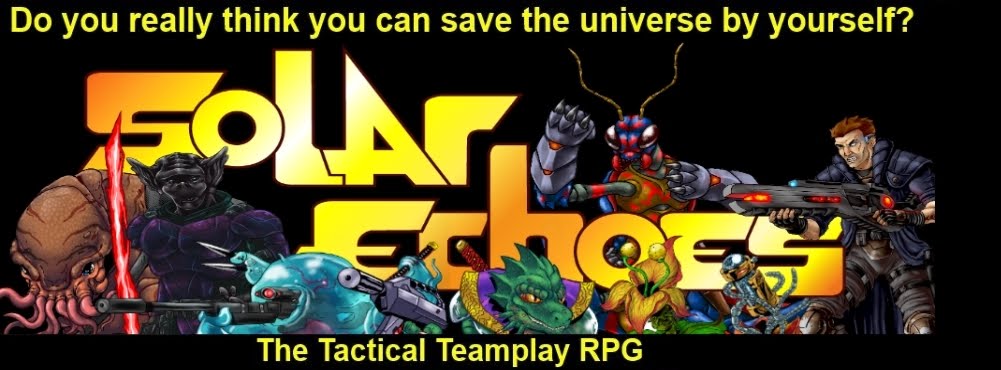
As seven alien races struggle to co-exist in an uneasy alliance, the Inter-Stellar Union sends Union Guard agents on missions to preserve the crucial balance. These specialized operatives must do what regional security cannot, dealing with smugglers, pirates, terrorists, and even greater challenges in order to bring stability to a universe that needs it desperately. Without the Union Guard, the races will not be prepared to face a looming alien threat they can only hope to defeat together.
Friday, March 10, 2017

Thursday, March 9, 2017
New Rule Change Coming Soon!
If you've played Solar Echoes before and remember the dice system, we are considering a few small changes. We've reviewed the probability calculations and the numbers are where we want them, so now all that remains is some playtesting. I'll be running the new system at the next few conventions I attend, but if any Solar Echoes groups would like to playtest it and give us your feedback, we'll send you some free stuff! Message me for the details of the new system if you're interested. We really appreciate any beta-tests from gaming groups, and hope that you like the new design! The changes are being made for several reasons:
1. If your attribute score is 4 and you roll 4 dice, it sometimes felt a little too easy to get a 6, which is nearly the highest roll you can get on a 6-sided die in Solar Echoes (in the old rules, two or more 6's equals a 7)
2. Rolling dice didn't feel very exciting most of the time, but we've added in a little something to watch out for that will add some risk!
3. In the old system, people were disappointed when they rolled three or four 6's and we told them that “two or more 6's equals a 7.” Not so anymore!

Wednesday, March 8, 2017
Demo Kit Beginnings
This last week I've been working on
designing a short demo-kit for introducing new players to Solar
Echoes. Much of it is based upon the content in the Starter Kit, but
it is going to be much shorter, with a learn-as-you-go approach. I've
always run things that way at conventions, using the Gun Runners
mission in the Starter Kit as a teaching tool, but the demo-kit is
designed for other GM's to pick up easily and play the game right
away, teaching the game to new players as they play. I've always had
a bit of an advantage running the Starter Kit, since I know the game,
but I'm hoping the demo-kit will help new GM's pick this up quickly.
As I'm putting this together, I'm taking advantage of the tricks I've
learned with Photoshop for colorizing some of my old artwork. Check
out a couple NPC portraits I've colorized and altered for a new look!

Tuesday, March 7, 2017
Dice and Statistics
Recently, I've been examining the
probabilities inherent in the Solar Echoes dice system, and the
numbers are where we want them for the most part. However, through
some of the games I've run at conventions, a few players have talked
about the feeling of the dice system and I have decided to make an
appendix entry in the Player's Guide. This entry will clarify the
actual chances for rolling certain numbers, detailed in percentages,
so it is easier for players to see what is going on behind the
mechanics of the system. In addition to this, I've also been reaching
out to a few people online to help with more complex aspects of our
dice system—I'm looking for experts in statistics. The Solar Echoes
dice system, like some gambling games, has a few hidden angles that
I'd like to bring to light for players looking to maximize their
understanding to make better tactical choices in the game. Standing
in the middle of the room while someone is shooting at you is not
wise--if players know their exact chances, I'm betting they'll be
keeping behind cover much more often!
Friday, March 3, 2017
Game Mileage Varies By Age (part 5)
The last aspect of a game that I can
think of which might affect certain age groups is the difficulty
level. Games like Dark Souls are known for their punishingly brutal
levels of difficulty, but they have done very well and are quite
popular. Perhaps difficult games for the “hardcore” gamer are
welcomed because there are a lot of games that are too easy—designed
for the totally casual gamer that plays games on their smartphone
once in a while. With difficult games, mileage varies, because I
think most gamers will give up quickly if there isn't a method for
improving. Practice was mandatory for most of the arcade-style games
in the 80's, with space-shooters like Gradius requiring actual
memorization of enemy patterns to survive. Ghosts 'n Goblins was
another game that required tremendous practice, but it was possible
to solve...if you had insane amounts of time and patience. I'm glad
that there are still games being made today with punishing levels of
difficulty, because they teach kids perseverance and determination,
just like practicing a musical instrument does. If the game is
well-designed, fun, and rewarding, adults also enjoy extremely
difficult games. But I'm also glad there are games that don't require
as much of me to move forward—at the end of a long, tiring work
day, I just want to have fun and feel like I'm accomplishing
something without having to stress about it.
Thursday, March 2, 2017
Game Mileage Varies By Age (part 4)
Another thing that I think should be
part of every game developer's basic creed is to allow saving just
about anywhere in the game. The old concept of “save points” was
something done in 80's and 90's games to create challenge—if you
couldn't get far enough to a save point and “died” along the way,
you'd have to start back at the last save point. For a few types of
games (such as arcade-style), I understand this, but for most games,
mandating save points is almost a guarantee that most adults won't be
able to enjoy or complete the game. I remember Final Fantasy VII,
which I purchased along with a brand new Sony Playstation back in
1996. I also happened to be finishing up my Master's Degree at the
time, and when I found myself staying up until 2am to just get to the
next save point so I didn't have to do everything over again the next
time I played, well...that was when I decided I had to quit the game,
cold-turkey, so that I could keep my grades up and finish my degree.
These days, when I consider buying an RPG, I'll scour the reviews to
find out if it allows saving at any time. If it doesn't, but it's
available for the PS Vita (the handheld Sony game machine), I'll buy
it on that because it at least allows me to pause the system and put
it in standby until the next time I want to play—allowing me to
resume exactly where I left off, even if the game didn't allow me to
save. Interestingly enough, the PS Vita is well-known as one of the
best RPG game machines out there. I wonder if it's because of that
feature?
Wednesday, March 1, 2017
Game Mileage Varies By Age (part 3)
I sometimes never come back to a game I
really liked because every time I've tried, I couldn't figure out
where to go or what to do next. The problem with adult gamers is that
we can't sit down religiously, on a daily basis, and remember where
we left off. Sometimes we might not have free time to spend on a game
for days or weeks. Once in a while, I load up a game and I notice my
last save was months ago! If that game doesn't have some kind of
information to remind me what quest I was doing the last time I
played, I may find it impossible to pick up where I left off. If it
starts me in the middle of a vast map without a marker on the map to
even show me where I'd been headed, I might wander the wrong way and
waste an hour or two—that's relaxing time that is much more
valuable to an adult because there is so little of it available when
we have jobs and a family. I know game developers have target
audiences, but it seems an immense oversight when designers leave out
any method for tracking your objectives. I even remember a time when
a lot of RPG's had complex maps that you'd need to map out by hand.
That was actually a little fun, but with today's technology and
gaming environments, an auto-map should be included in every game by
default. If you want to relive the hand-mapping nostalgia, maybe just
make the auto-map a feature you can turn on or off? Most of my
abandoned, unfinished RPG's were discarded because of many hours of
aimless wandering. Quest journal? Auto-map? Save-anywhere? These
should be standards in RPG's!
Subscribe to:
Posts (Atom)