Tuesday, October 11, 2016

Writing an Entire Universe (part 2)


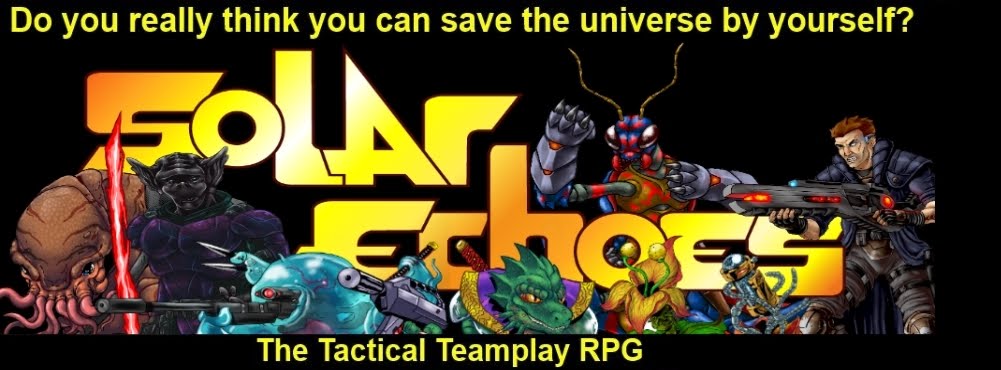
The Solar Echoes universe naturally began with the characters--the alien races. We designed each of the races based on what we thought were the best survivors on earth. If any life from earth was to survive on another planet, what would it be? Insects were an easy and obvious choice, so the Chiraktis was born, which I designed based on the mantis with some grasshopper added in for a tougher appearance. An aquatic creature that has lived in our oceans since ancient times--the Nautilus--inspired my design of the Archaeloid; I turned the nautilus upside-down and added some lobster-like arms and legs. Giant reptiles once roamed our planet, and may still if not for the catastrophe that wiped them out, so the Krissethi was another obvious choice, it's appearance based on a fusion of an guana and a chameleon. I feel sorry for the artists, though, because I was especially picky about the Krissethi's look, since I once had a pet iguana and love lizards! Of course admitting this reveals my bias towards wanting a reptilian race in the game.

The plant-race, the Erwani, was Matthew's area, because he is quite an expert when it comes to anything botany-related. We both fondly remembered the 80's computer game, "Starflight," and the plant alien we'd sometimes encounter in space, so we loved the idea of having intelligent vegetation in our game. As for the Omul, that was inspired by a sci-fi novel I'd been writing back in high school about alien amoebas invading the earth. Plus, the top of our list for the most likely life in outer space was single-celled organisms, so the formless Omul made a lot of sense. The Reln was based on our decision that players needed a choice of something similar to humans, but different enough that it still felt unique. We struggled on that at first, and when a dog-like race was proposed, I was very against it, but it wasn't until I did my best to make the concept look "cool" in my sketches that it was finally agreed that we drop the idea--my sketches were decent, but dog-aliens just didn't feel right for Solar Echoes (werewolves in space? Gnolls with guns? No thanks.) Instead, we decided bats were great survivors, so we loosely based the Reln humanoid on the bat, especially considering that the Reln spend much of their time underground in the dark, due to the intense radiation of their resonance-locked sun.

Monday, October 10, 2016

Writing an Entire Universe (part 1)


When I was developing the Solar Echoes game initially, I worked with a friend of mine, Matthew Hannum. Though we spent nearly two years developing and testing the rules system, we also spent those two years talking about the game world we were designing. We often began with questions, like, “What type of organism would most likely survive on another planet?” and “What would the culture of an intelligent reptilian species be like?” Yet this was much bigger than designing a single world--we were designing an entire universe! If we'd had any idea when we started how big this would become, I think we'd have been overcome and might not have finished. It reminds me of one of my favorite quotes from my wife, when she and I decided to repaint our entire basement. When we finished, two full days later, she said, "It's amazing what you can accomplish when you have no idea what you're getting into!"

Friday, October 7, 2016

Was the Jetsons Cartoon Prophetic? (part 5)


In the Jetsons, Rosie was a household robot maid that served the family. Today, we already see robots in the home such as the Roomba--a robotic, roaming vacuum, or Spykee, a robotic, roving dog that enables the owner to access its mobile webcam and keep an eye on things around the house. For instance, you can log into your robot spy through your smartphone and shout to your dog to get off the couch when you're not at home. There are other robots that have made their way into homes, such as Rockaroo—a robot that will rock your baby for you, Litter Robot LRII--a cat-litter changing robot, Robomow—an electric grass-mowing robot, Nanda Clocky—a robot alarm clock that drives away to get you out of bed in the morning, and even Agent 007—a security robot that patrols your home and monitors your doors and windows, shouting “Freeze, police!” at intruders. These robots aren't nearly as sophisticated as the Jetson's Rosie, but robotics is advancing so fast, it is just a matter of time!


Thursday, October 6, 2016

Was the Jetsons Cartoon Prophetic? (part 4)


Space travel was part of life in The Jetsons, and the family sometimes visited the moon. Today, the option for commercial spaceflight is nearing reality, with companies like Virgin Galactic and Space X offering flights to the space station as early as 2017. The cost? A mere $250,000. Many have already reserved their seats! But the space station isn't the only possible destination, as talks for colonizing Mars become more and more serious each year. Projections are made that manned missions to Mars may occur before 2035, and plans are being developed for actual habitation. However, Elon Musk himself, the wealthy visionary behind Space X and the plans for the colonization of Mars, has said he doesn't want to be the first person on Mars because he doesn't want to die.


Wednesday, October 5, 2016

Was the Jetsons Cartoon Prophetic? (part 3)


Flying cars are the exciting news, since they haven't exactly taken off yet. Other technologies envisioned in the Jetsons, however, have. Flatscreen TV's and interactive flatscreen computers were commonplace in the Jetsons, mounted on walls like paintings. It's unfortunate some of our favorite classic science fiction shows and movies failed to predict this, because seeing the inside of starships outfit with clunky CRT computer monitors really ruins our suspension of disbelief. Not only were flatscreens commonplace in The Jetsons, but video chats were also a feature of the futuristic TV show. Today, Skype, FaceTime and others all allow for us to visually chat, real-time, with people anywhere in the world. Video-chat and video-conferencing is widely used in business, and it has become so common that it is considered as only a feature on most devices. It's impressive that the writers of Jetsons saw this coming back in the early 1960's!

Tuesday, October 4, 2016

Was the Jetsons Cartoon Prophetic? (part 2)

Have you heard of Terrafugia? Maybe you've heard of the vehicle they are developing, the Transition? The Transition is a hybrid electric flying car with vertical takeoff and landing (VTOL) capabilities that won't require an airport runway, and it will drive on all roads and highways. It appears that the current move is towards automated flying, where you just tell the car where you want to go, and it will fly you there. Automated piloting isn't something unheard of—Google has been developing self-driving cars for several years now. Uber has also been looking into self-driving cars, and they have been researching VTOL technology. Jeff Holden, Uber's head of product, claims that in 10 years, “passenger drones” may be ferrying you to your destination through the skies!

Monday, October 3, 2016

Was the Jetsons Cartoon Prophetic? (part 1)


Was the future depicted in “The Jetsons” cartoon far-fetched, or...strangely accurate? The cartoon was first aired in 1962, and later revived with new episodes from 1985 to 1987 in full color. It wasn't long ago that we might have chuckled at the suggestion that anything in the Jetsons would actually happen (if you even remember the show!), but as we approach 2017, it's looking like the futuristic cartoon may have been right—about a lot! Back in the 80's, many of us earnestly believed that flying cars would be a thing of the future. Movies like the “Back to the Future” series show flying cars as a way of life only a generation away. The setting of the Jetsons was also around the same time-frame, taking place in 2062. As we look around in frustration, feeling disappointed that flying cars never happened, something you might not have known about is brewing...