Contact with aliens doesn't always work
out, if we're to learn anything from science fiction. While programs
like SETI (Search for Extra-Terrestrial Intelligence) are intended to
listen for signals in space, are we really prepared for what might
happen if we do come into contact with an alien intelligence? In the
movie, Species, SETI detected signals from an alien source, first
with information about a clean-burning fuel, and then a second signal
with an alien DNA code and friendly instructions on how to combine it
with humans. The results? A dominant alien species with the potential
to wipe us out. Other movies and TV shows have taught us that aliens
who show up in big spaceships and park over major cities probably
don't have our best interests in mind. Sometimes, they're here for
our resources or the planet itself, other times, they intend to
enslave us or use us for food (Independence Day, V, Falling Skies,
etc.) Sometimes they just want to get inside our heads or they intend
to clone us. Other reasons include: terra-forming our planet to suit
alien needs, biologically altering our children to become aliens,
stealing our water, or even going on a joyride to destroy everything
for fun. I'm sure I've missed a few, but science fiction has
presented a large variety of reasons why we shouldn't be so eager to
make contact with an alien species. Have we really considered and
planned for the possibility that their reason for contacting us might
not be friendly?
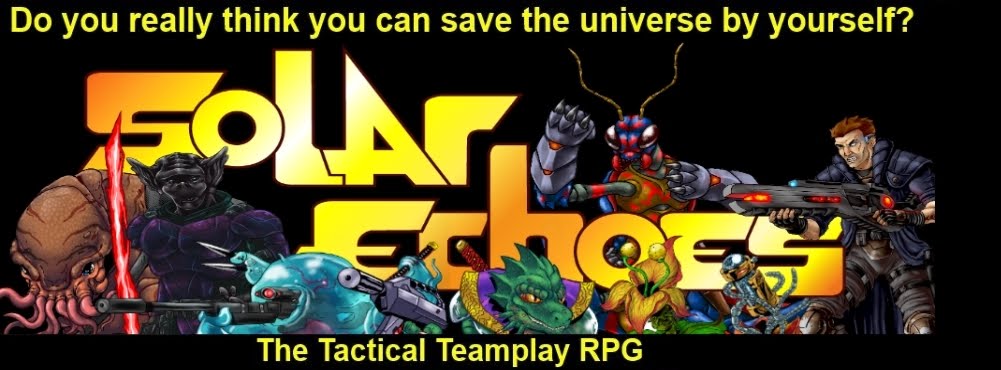
As seven alien races struggle to co-exist in an uneasy alliance, the Inter-Stellar Union sends Union Guard agents on missions to preserve the crucial balance. These specialized operatives must do what regional security cannot, dealing with smugglers, pirates, terrorists, and even greater challenges in order to bring stability to a universe that needs it desperately. Without the Union Guard, the races will not be prepared to face a looming alien threat they can only hope to defeat together.
Wednesday, April 30, 2014

Tuesday, April 29, 2014
What have we learned from sci-fi? (part 2)
Time travel can get very messy! Is time travel possible, though? Discussing that here would require volumes of information, and we would still walk away wondering, as there are many confusing theories on this topic. However, many do think that time travel is plausible—time dilation, a predicted result of Einstein's theory of general relativity—might be a very realistic result when moving across spacetime. Countless sci-fi movies and TV shows involve time travel, but each one can be seen as a warning: time travel will result in a massive mess. Back to the Future shows how traveling back in time could potentially erase your own existence. Continuum, a TV show currently in its third season, becomes more convoluted with each passing week, demonstrating that multiple timelines, paradoxes, and collapsing realities await even a careful time traveler. Dr. Who, a “time lord,” demonstrates the burden of a time-traveler, constantly trying to fix the universe and prevent major catastrophes. In The Butterfly Effect, even the smallest deviation can erupt in massive changes. And in 12 Monkeys, a man sent back in time to prevent the release of a deadly virus may have inadvertently caused the release of the virus by traveling back in time. If all this isn't enough to make your head spin, one thing should at least be clear—time travel is extremely dangerous!
Monday, April 28, 2014
What have we learned from sci-fi? (part 1)
Be afraid of AI and robots! Isaac
Asimov's story, “I, Robot” showed us that, despite programming
efforts to encode a set of laws, AI can find a way. “The
Terminator” showed us that Skynet, an artificial intelligence
defense system, was first built as a "Global Digital Defense
Network" and given command over all computerized military
hardware and systems. Skynet eventually concluded all humans were a
threat, not just those it was programmed to protect, and sent its
robots out to destroy the entire human race. In “The Matrix,” the
human race has already been subdued by an AI system and forced into
unconscious slavery. Yet despite all these and many other great
stories and movies, we are still moving steadily ahead on the same
path, giving our military drones more and more autonomy, developing
AI's to conduct warfare for us, and developing towards the point that
AI will become more intelligent than humans by 2029. Haven't we
learned anything from sci-fi? We'd better, before it's too late...
Friday, April 25, 2014
What concepts from science fiction are becoming reality? (part 5)
A few other concepts-become-reality:
Minority Report's face scanner is now common tech on smartphones and
tablet computers. Biometric scans are commonplace today--fingerprint
scanners and face recognition technology can be found from the Apple
i-phone to Sony's PS4. Most of us are familiar with the “replicators”
in the Star Trek series—devices that could generate items out of
thin air. Yet today, this isn't as far from reality as we might
think, considering the 3D-printing revolution. Just buy the plans for
an object online, and your personal 3D-printer can produce the item
for you in minutes. Would you like to send a copy of your child's
clay sculpture to her grandparents that live on the other side of the
country? Just place the object on a scanner, scan, and send the data
to their 3D printer. They'll have a physical copy in just minutes.
Even houses are being built by 3D printers, and complex objects, like
firearms, can also be printed as parts to be assembled. Just imagine
what the pirating problem will be like in the future when everyone
has one of these!
Thursday, April 24, 2014
What concepts from science fiction are becoming reality? (part 4)
In the movie, Prometheus, the ship's
crew tosses a few robotic orbs into the corridors of an ancient alien
ship. The robotic drones fly through the ship scanning the area to
produce a detailed, holographic map. Today, Google has essentially
been doing the same thing with Google Street View, sending out cars,
bikes, and even snowmobiles to geo-map as much as possible. These
images are tied to GPS coordinates, and Google has even mapped the
interior of some buildings. However, the movie Prometheus was
released after this technology had already been developed, but the
concept of geo-mapping robotic drones is still sci-fi, only because
it hasn't been done yet with robots. The lasers emitted from the
drones in the movie suggest something similar to the lidar used by
current satellites to map the topography of glaciers. Essentially,
the drones in Prometheus aren't much of a stretch considering current
technology, but sci-fi has a way of taking current tech and advancing
it just a bit further.
Wednesday, April 23, 2014
What concepts from science fiction are becoming reality? (part 3)
In “The Avengers,” Iron Man
manipulates a number of holographic computer displays with just a few
movements of his hand. We also saw this type of technology in
“Minority Report.” Today, this technology is being developed, and
motion controls already exist through Microsoft's Kinect or Sony's
PS-Eye. With the 2012 BMW 3-series, you can see your speed, the
posted speed, and an arrow pointing the way for navigation, all
displayed on your windshield as a sort of “Heads Up Display”
(HUD). HUD's are already used on many fighter planes. To experience
personal augmented-reality, Google Glass is the current option—a
hands-free smartphone designed as a pair of glasses which responds to
voice commands.
Tuesday, April 22, 2014
What concepts from science fiction are becoming reality? (part 2)
A sci-fi short-story that I wrote back
in high school, over 20 years ago, featured a device I called the
“PS-TV,” short for “Plexi-Screen TV.” Imagine a fruit roll-up
(if you remember those from the 80's) or a thin piece of flexible
plastic you could roll easily into a tube. The piece of plastic would
actually be a digital display, and in my story, people unrolled the
screens to watch TV, then rolled them back up and stuck them in their
pockets when finished. This technology has been developed during the
last few years--just look up “flexible screen TV's,” “flexible
OLED,” or “Willow Glass.” Before high-school in the early 80's,
I remember making notes about an idea I had for a 1st-person video
game where you could look around you, see your own hands gripping a
sword and shield, and embark on an epic adventure from this
viewpoint. Today, such things are finally being explored in the video
game industry through the Oculus Rift and Sony's Project Morpheus.
Subscribe to:
Posts (Atom)