The first thing a good GM has to do is prepare, which is similar to all the pre-production necessary for a film. A GM has to have a good "script," whether it is a published adventure/mission or something he wrote himself. He needs to be really familiar with the story, the characters, and the sequence of events, because no player wants to sit around at the table and wait for the GM to read through things to figure out what is supposed to happen next. A good GM will have read through the adventure beforehand, most likely making notes to himself, highlighting or underlining important areas. He will also have player hand-outs ready, battle maps prepared, and even have a selection of props and other visual-aids to enhance the experience for players. Personally, I like using 3D-printed miniatures, hot-wheels cars, lego starships, and other fun toys for props when running Solar Echoes games. I even used to sculpt, bake, and paint clay figures of my own design for unique creature encounters!
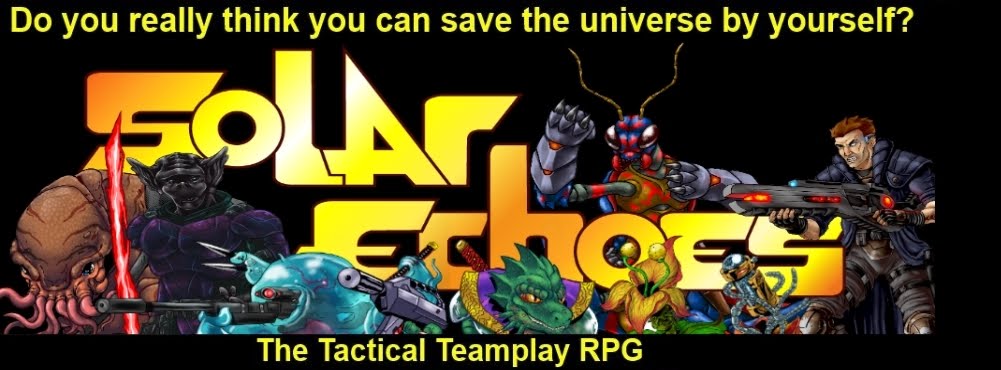
As seven alien races struggle to co-exist in an uneasy alliance, the Inter-Stellar Union sends Union Guard agents on missions to preserve the crucial balance. These specialized operatives must do what regional security cannot, dealing with smugglers, pirates, terrorists, and even greater challenges in order to bring stability to a universe that needs it desperately. Without the Union Guard, the races will not be prepared to face a looming alien threat they can only hope to defeat together.
Tuesday, January 31, 2017

Monday, January 30, 2017
The Art of GMing (1/5)
A GM, or "game master," is
the person who runs a role-playing game session for other players. In
Solar Echoes, we call the GM an MC, or "Mission Controller."
The role of a GM in any RPG is to tell a story, make sure game rules
are followed, act out any of the characters that players encounter
during the game, and manage all game challenges, such as combat or
hacking. Being a GM can be a very demanding challenge, but if you
like telling stories and presenting exciting encounters to players,
it can be more fun than being a player, in my opinion. If you've ever
wondered what it might be like to be a movie director, GMing an RPG
is a similar experience (I've directed several short films, and there
are a lot of parallels.) But what does it take to be a good GM?...
Friday, January 27, 2017
Sneak-peek at New Art!
Sneak peek at new art being done by artist John Fell! The fight between
the Archaeloid and Omul is almost finished--think of the Archaeloid in
this battle as a samurai and the Omul as a ninja. We worked really hard
to get the Omul stance right. It's so difficult to make a formless
creature like the Omul appear asymmetrical with movements full of
kinetic energy, but I think we got it in this instance. We looked at a
lot of martial artists fighting, especially kendo masters, to get ideas
on form. I'm very happy with how this is turning out!


Thursday, January 26, 2017
Behind the Scenes: 3D Starship Miniature
I've been working with a new 3D-sculpting artist, Charles Oines, on design plans for 3D-printed Solar Echoes starship miniatures. We decided to start with the Reln Voidrunner, based on Jay Darnell's original starship artwork from the Player's Guide. Here is a comparison, showing the black & white artwork superimposed over the CG render of the progress on the 3D model so far. The miniature will be small, about 2 inches long and 1 inch wide. In Solar Echoes starship combat, distances are abstracted so starship size doesn't matter (personally, I use big lego ships), but to keep printing costs down, I'm trying to keep the models small. However, I may also include a larger version of the starships for those that want to pay the money to print a big model!

Wednesday, January 25, 2017
Colorization Project
I've recently tried colorizing some of the black&white art I have from various Solar Echoes artists. The upcoming Explorer's Guide will feature some of this, and future products may as well. It is a long process--I need to "stay within the lines" so to speak, but when using Photoshop, I'm able to keep the original shading by the artist with the new color additions. Below is an example of something I'm currently working on. I'm still undecided on the color of the Krissethi's shirt--what do you think would go well with his purple pants and green skin? Purple is typically a color of royalty or wealth, so it makes sense that the status-oriented Krissethi would wear it (and lots of bling) in an ostentatious display.

Tuesday, January 24, 2017
The Ethical Machine (part 2)
Some scientists involved in the move to bring self-driving cars to our streets complain that progress could be stalled if cars must be equipped with an ethical engine. One scientist, from the Virginia Tech Transportation Research Council, states that cars are already programmed to make choices, such as slowing down and leaving space after detecting a bicyclist. This is considered “risk management” instead of ethical consideration. Driverless cars currently aren't able to determine the age of a pedestrian or the number of occupants in a car, so MIT's Moral Machine consensus information is considered redundant regarding driverless car development.
Monday, January 23, 2017
The Ethical Machine
Driverless cars have recently brought artificial intelligence considerations to the public. MIT researchers have put up a website called the Moral Machine where you can take a survey and decide who should live and who should die in a car accident scenario. The idea behind this survey is that the consensus will then become part of an automated car's AI program, calculating the "best" outcome in a car accident situation where someone is going to die. The brakes are out, should the car veer left into a homeless man, or right, into a pregnant woman? Interestingly, most voters have chosen the car occupant's death over that of anyone outside the vehicle--but the voters also indicated they would never get in such a car!
Subscribe to:
Posts (Atom)