I'm
writing the new mission, Broken Citadel, as both a sequel and a
stand-alone mission. If players have already completed Void Hunter,
Broken Citadel will pick up exactly where their characters left off.
However, if a new group of players are jumping into Broken Citadel
without prior knowledge of the events in Void Hunter, it will still
be a simple transition for those players. They will hear about the
crucial events of Void Hunter through NPC's gossiping about what
another team of agents did on the Void Hunter mission, and they will
learn more details from an NPC character encounter near the beginning
of the Broken Citadel mission. This character will shed light on
events for both new players and Void Hunter veterans.
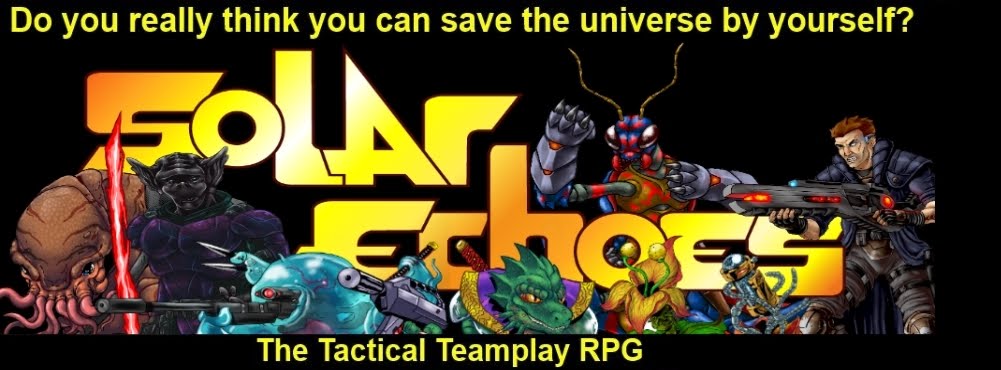
As seven alien races struggle to co-exist in an uneasy alliance, the Inter-Stellar Union sends Union Guard agents on missions to preserve the crucial balance. These specialized operatives must do what regional security cannot, dealing with smugglers, pirates, terrorists, and even greater challenges in order to bring stability to a universe that needs it desperately. Without the Union Guard, the races will not be prepared to face a looming alien threat they can only hope to defeat together.
Tuesday, October 10, 2017

Monday, October 9, 2017
Writing a Mission Story-Arc (part 1)
A
few months ago I ran a poll to find out what people were most
interested in seeing next for Solar Echoes. The highest percentage of
votes was for an overarching story across multiple missions. You may
not have known it back when it released in July, but Operation: Void
Hunter was the first installment of a larger story. Part 2 of that
story is now underway, and it is currently titled Operation: Broken
Citadel, planned for release around Thanksgiving. The very first
gamers that will get to try the mission will be gamers at the
Chessiecon convention over Thanksgiving weekend. But what if those
gamers aren't familiar with the events in Operation: Void Hunter?
Friday, October 6, 2017
The Versatile GM (part 4)
Sometimes
a GM will encounter individual players that can change the tone of
the game for the group. This is sometimes related to that player
having a different style preference than the other gamers in the
group, or it can be due to personality differences. In cases like
this, the GM may have to adjust the game slightly to include
something for everyone. If that player is too extreme in his
preference or approach as compared with the rest of the group, the GM
might need to have a side discussion with that player and see if a
compromise can be reached. In other instances, a player might just be
too sophisticated or too immature for the rest of the group. If this
is the case, the GM can challenge that player or the group to help
“manage” each other. I've seen a young child playing the game
with a group of adults, and the adults worked to guide the young
player, even making up stories to fool the young player into behaving
a particular way. It can be a fun experience if you have the right
make-up of personalities, but if an ongoing conflict persists, it
might be time to ask a player to join a different group that would be
more suited for their playstyle. In the end, the goal is for everyone
to have fun playing an RPG and to walk away with great memories of
the experience. The GM needs to stay versatile and creative in order
to make an RPG fun for the players!
Thursday, October 5, 2017
The Versatile GM (part 3)
Some role-playing gamers would rather spend hours in discussion planning every move carefully, arguing over the best possible approach until everyone has a very specific role to execute at a very specific time. Paralysis-by-analysis can certainly slow the progression of a game, but it is the GM's job to discern whether his players are spending so much time planning because that is what they enjoy, or because the GM has left things too vague or has failed to provide proper incentives. If a gaming group is spending too much time planning and seems reluctant to take action, the GM can prompt players to act by creating time-sensitive situations. Another technique a GM can use is the call for certain skill checks from his players, revealing information to them if they successfully use their skills. For example, the “Resourcefulness” skill in Solar Echoes is a rather open-ended skill that can serve as a gateway for GM hints to the players. Not sure what to do here? Succeed at a Resourcefulness check, and suddenly your character “realizes” that he can utilize a particular environmental advantage, an object, or something else to help achieve goals.
Wednesday, October 4, 2017
The Versatile GM (part 2)
One
type of RPG gaming group is the combat-shy crowd; I've run games for
groups like this and they prefer to focus on the role-playing aspect
of the game so much that they will actively seek to avoid every
possible combat encounter. As a GM, it is important to adjust the
scenario to involve more dialogue-intensive situations where the
threat of combat looms but can be circumvented through clever
wordplay. These types of players are interested in story and
character development, so the GM needs to be a good story-teller and
an entertaining actor, in addition to being skilled at improvising.
However, another type of gaming group is the combat-hungry crowd,
where the players would much rather enter battle than try talking it
out. The GM will need to keep dialogue and narrative sections short
for players like this, and move from one action scene to the next in
order to keep the attention and interest of the players. If a GM
prefers a different type of gaming style than his players and has
trouble adjusting, then it might be time to consider finding a new
gaming group with similar preferences to the GM.
Tuesday, October 3, 2017
The Versatile GM (part 1)
If
you are a Game Master (GM) and play RPG's with others, you probably
have experienced a few different types of gaming groups. There are
different styles of GMing necessary for each type of group, and if
the players are going to have fun, it is up to the GM to figure out
how to adjust to and manage the players. If a GM doesn't know his
players' preferred gaming style, conflict and boredom can derail a
gaming session quickly. The GM has to be extremely flexible and be
ready to wear a variety of “hats” in order to accommodate the
preferences of his gaming group. It is likely that conflict will
arise if a player's style is not being considered, because a player's
boredom often results in that player becoming a volatile maverick in
the gaming session. A bored player might try to “spice things up”
by random acts of destruction or by having his character behave in an
overly aggressive or inappropriate way. However, entire groups of
players sometimes enjoy being incredibly destructive in a scenario—it
may not be the result of player boredom. If this is the case, the GM
has two options: he can either shift his focus to providing
over-the-top combat opportunities as if the players are in a Michael
Bay movie, or he can try to discipline his players with dire
consequences in the game for their crazy behavior with the hope of
getting them refocused and back on track. Ultimately, though, the GM
should prioritize player fun over his desire to follow his plans for
the adventure—otherwise, there might not be any players around for
the next gaming session.
Monday, October 2, 2017

Subscribe to:
Posts (Atom)