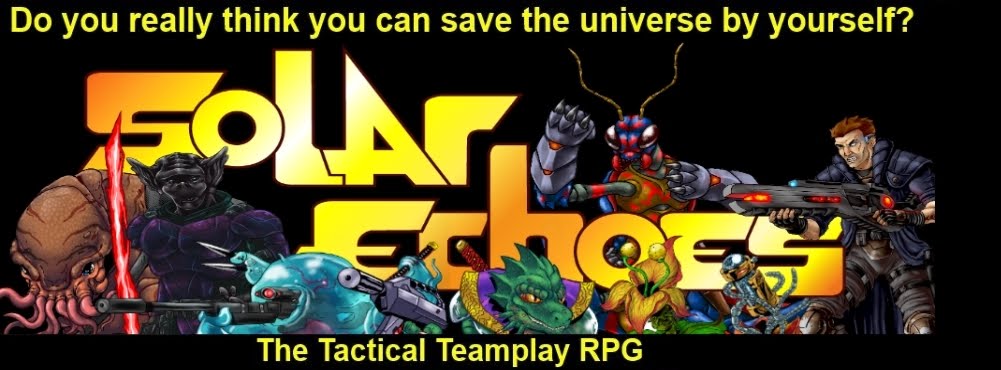
As seven alien races struggle to co-exist in an uneasy alliance, the Inter-Stellar Union sends Union Guard agents on missions to preserve the crucial balance. These specialized operatives must do what regional security cannot, dealing with smugglers, pirates, terrorists, and even greater challenges in order to bring stability to a universe that needs it desperately. Without the Union Guard, the races will not be prepared to face a looming alien threat they can only hope to defeat together.
Friday, April 10, 2015
Solar Echoes at JohnCon, April 10-12!
If you're in the Maryland area this weekend, join us at the Johns Hopkins University for the JohnCon where we'll be running Solar Echoes missions for new players!

Thursday, April 9, 2015
Challenging Players: Environmental Effects
The MC has the
responsibility of creating a challenging scenario for players and
must keep it interesting. One method detailed in the MC Guide
involves using environmental effects to add variety to the
battlefield. For instance, a smoky or misty environment will affect a
laser sight and cause a bloom effect, which negates the bonus
provided by the laser sight and also highlights the location of the
gun. Radiation, wind, darkness, ice, and fire are but of few of the
other environmental effects that will have a notable impact upon
combat scenarios, some of which will affect certain races more than
others. For instance, Omuls take 1 additional point of damage from
fire, but Reln suffer 1 less damage from radiation effects.
Wednesday, April 8, 2015
Inside Information
One of the
reasons we decided to write the Mission Controller's Guide is because
we felt there was a lot of information that should be “MC Only.”
Details about several new alien races or robots that could pose a
significant threat to the character races are included in the MCG. If
we had included this information with the Player's Guide, there would
be fewer surprises and a lot less intrigue if players could study it
beforehand. Plus, what better way to establish formidable villains
than to keep them shrouded in mystery? You won't learn all the
secrets of the Solar Echoes universe in the MCG (we have to keep some
of it up our sleeve for future releases,) but you'll learn quite a
lot--far more than your unsuspecting players!
Tuesday, April 7, 2015
Flavor Text: What is it?
We have a lot of setting information in both books, though we kept it separate from rules text to make it easier to quickly reference our rules. Our setting info is in what we call “Flavor Text Boxes,” which are colorful, graphical boxes throughout the book with fun, informative, or even comical text relating to the chapter it is found in. Below is an example of informative flavor text:
"The Erwani tend to feel slightly out of place, being the only plant-life among the other 'animal' races. Despite this, they consider themselves almost as if they are wizened elders compared to the shortsighted, short-lived, and impulsive behavior of the others. However, the Erwani don't view the other races with contempt, but instead take it upon themselves to try and be caretakers and mediators to help everyone get along."
Friday, April 3, 2015
Is Dystopia All We Can Foresee? (part 5)
If a utopian
science fiction story was to be successful, I think it would have to
involve the struggles to produce such a society. It would involve the
concept of equality and freedom for each individual, and the choice
to pursue and achieve dreams by those working hard to achieve them.
In dystopias, government is usually oppressive and controlling, but
if a utopian story was written, it would probably involve a
government that listens to its people and doesn't try to overstep by
telling them what they can and can't buy, how much they can earn,
what religion they can practice, and how they are to speak. Imagining
a utopia like that might not seem too impossible to believe,
especially since that was what the writers of the Constitution of The
United States of America hoped we would have...and keep. Dystopia
seems much more realistic to us now, though, especially since those
who want to control us and deprive us of such things (because it
threatens their power) are now telling us that those utopian
qualities aren't good for us, after all. Maybe George Orwell was
right about the future—he just got the year wrong!
Thursday, April 2, 2015
Is Dystopia All We Can Foresee? (part 4)
Consider the
popularity of Edward Bellamy's Utopian novel, “Looking Backwards,”
published in 1888. The novel was immensely popular during its time,
capturing the imaginations of people with the concepts of increased
equality and reduced labor. Yet when socialism clearly failed to
deliver the promised paradise but had instead resulted in stagnant
wages, bad housing, the rarity of car ownership, and eroding
freedoms, dystopic novels such as Orwell's “Animal Farm” and
“1984” sounded with clarity the dismal future of such societies.
If science fiction is a reflection of the times, maybe times were so
rough in 1888 that a utopian vision was more appealing. Or, perhaps
times weren't that bad at all, and a utopian vision seemed within
reach?
Wednesday, April 1, 2015
Is Dystopia All We Can Foresee? (part 3)
Science fiction
involves a number of unique factors, but one crucial part is the
ability of the reader to identify with the futuristic vision that is
created. If the fictional world presented to the reader is too
perfect and happy, this fictional world is likely to be rejected.
There is one sci-fi series (I won't name names, to avoid offending
any fans of this particular show) that I was never able to get into,
and the reason was that the fictional world seemed too perfect to
me--too clean, too well-ordered and convenient. I'm not saying I like
all my sci-fi to be gritty and harsh, but I just can't imagine a
future involving humanity where they have solved all their problems.
Utopia seems a naïve concept, or something imagined by the leader of
a cult, not something practical or realistic in today's world.
Subscribe to:
Posts (Atom)