The easiest type of civilization to
identify with is our own, which can be characterized as an industrial
society. This classification can cover a vast range of time, from
when mass production and technology first begin to emerge all the way
to when society is able to regularly travel to space. Typically,
technology is prevalent in industrial societies, and long distance
communication as well as instant information access is common. Most
civilizations in the industrial stage are, unfortunately, plagued by
infighting between nation states. Some parts of an industrial
civilization even experience pre-industrial living, and poverty is an
ongoing problem in both industrialized and under-industrialized
areas. When running a mission or campaign in Solar Echoes that takes
place in an industrialized civilization, the most common challenge
the MC will meet is that of familiarity. Players are most familiar
with industrialized civilizations and expect that they would mirror
our own, so the MC may find some players struggling to “suspend”
their disbelief and immerse themselves in a world that is expected to
parallel ours.
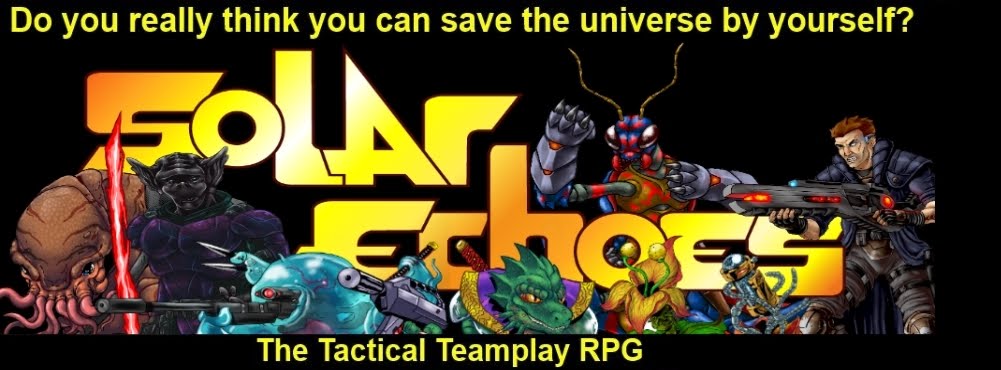
As seven alien races struggle to co-exist in an uneasy alliance, the Inter-Stellar Union sends Union Guard agents on missions to preserve the crucial balance. These specialized operatives must do what regional security cannot, dealing with smugglers, pirates, terrorists, and even greater challenges in order to bring stability to a universe that needs it desperately. Without the Union Guard, the races will not be prepared to face a looming alien threat they can only hope to defeat together.
Wednesday, December 11, 2013

Tuesday, December 10, 2013
Civilizations in Solar Echoes (part 2)
Imagine traveling
through space and discovering an alien civilization in a
pre-industrial stage of development! We always imagine alien cultures
to be more advanced than our own, but consider that an alien
civilization may be younger than our own, or may have faced
circumstances that prevented advancement at the same rate as ours. A
pre-industrial society can encompass a vast range of development, and
could involve an agriculturally-focused civilization with the
beginnings of cities all the way to a society that has begun to
manufacture goods and make technological advances to improve the
quality of life. These societies will have a basic understanding of
science but are likely to still believe in superstitions. Illiteracy
or at least poor education will be prevalent, communication over long
distances will be limited, and travel will be reliant upon natural
means. Medicine in a pre-industrial society is most likely inadequate
to deal with disease and overall poor health, which are common
challenges for a society in this state. If players visit a
pre-industrial world, it is less likely that they will be viewed as
“gods” but may be held in high regard for the knowledge and
technology they possess, though they might also be viewed with a
great amount of distrust and suspicion.
Monday, December 9, 2013
Civilizations in Solar Echoes (part 1)
Traveling around the vast universe in Solar Echoes can bring players into contact with all kinds of alien civilizations. The Mission Controller's imagination is literally the only limit to what the players might encounter. When we designed Solar Echoes, we considered that not all civilizations will be at the same stage of development as the 7 races in the Union. Imagine journeying to a distant planet and discovering intelligent life, and those beings were only in the early stages of technological development? The first type of society that we discuss in the “Mission Controller's Guide” is Neolithic society, which is very primitive and involves the use of only the most basic tools, where the people are living mainly as hunter/gatherers. What could it mean for players when they arrive on this planet? If they crash-landed, could they find the resources needed to repair their ship or signal for help? And how would the inhabitants of the planet view the players, who possess superior technology that would likely be viewed as “magic” to primitive people? Survival on such a world might become quite a challenge when the players' weapons run out of ammunition, and the players may have to learn to adopt the use of more primitive weapons to defend themselves against hostile lifeforms.
Thursday, December 5, 2013
Exploring Alien Culture (part 7)
The humans in
Solar Echoes have a similar culture to our own, but their experience
in space and the process of colonizing a new planet has changed some
aspects of human society. For one thing, the long journey wandering
through space in the “Ark” starship convoy has given humans a
certain resilience and comfort with space travel that is unmatched by
the other races. As a result, humans all have an innate talent for
piloting in space. In addition to this, the early struggles of
managing colonization on their planet, known as “New Terra,” have
allowed humans a versatility and adaptability that gives them an edge
over the other races. The initial government in New Terran colonies
was a Meritocracy, which developed out of the needs of the early
colonies. Responsibilities were assigned to individuals with the
appropriate skills needed to keep the colony running. Decisive and
intelligent people quickly became the chosen leaders. Eventually, new
roles were assigned when people in existing roles were unable to
fulfill their duties or perform them sufficiently. The colonies
finally divided into states ruled by governors, and appointments were
made through the votes of the colonists. Now that the Human
population has exploded upon New Terra, countless disputes have
arisen over appointments, with arguments ranging beyond merit and
skill to now focus on morality and character. Voters have become very
influenced by the campaigning of individuals seeking office, and
politics have slowed practical development. If this sounds familiar,
ask yourself if you think we humans will change much in the future.
Hopefully democracy will still be in style, because things certainly
could be worse (a dictatorship, for example.)
Wednesday, December 4, 2013
Exploring Alien Culture (part 6)
Archaeloid society is influenced a
great deal by the process their young must endure to survive.
Archaeloid young are left on their own in the great oceans until they
reach adulthood, if they can survive that long. Once they have
matured, these young adults are welcomed into society and a great
loyalty exists among Archaeloid people because of the respect they
have for each other for surviving the trials of the harsh ocean
environment. As a result, their society is structured to award anyone
who has developed a strong work ethic, and Archaeloids look down upon
anyone with a victim mentality—it is their belief that no one is
owed anything. Honesty is another aspect of Archaeloid culture
because Archaeloids reflect their emotions through skin coloration
involuntarily, which has made it difficult for them to lie
effectively. However, they are quite skilled in telling only the
truths they want people to know. The other races are quite aware of
this, and in some political situations, wild accusations have been
thrown at the Archaeloids just to see if they might confess to
anything.
Tuesday, December 3, 2013
Exploring Alien Culture (part 5)
Reln society is
focused on education, and those who are awarded places in the
government have gained that opportunity through recognition of their
many degrees and academic achievements. In Reln culture, education is
a life-long pursuit, not something that stops after one or two
degrees are earned. The Reln continue their education while
maintaining full-time or part-time work, throughout their lives, and
it is only when they retire that Reln are legally allowed to have
children (Reln are able to bear children throughout their entire
life, without age-related risks.) This society has suffered what many
now refer to as “educational inflation,” where keeping a job is
about staying ahead of others, continually adding on certifications
and degrees to remain competitive. Whenever they are not working,
Reln are constantly reading or researching, with a tenacity that is
driven by an obsessive fear of falling behind. In our own world, we
only need to look around us to see the same thing happening. This is
especially present in the medical community, but is also becoming
more and more apparent in other fields. With less and less time for
children because of the demands placed upon us by our jobs, how will
the human race cope with this shift in society? We don't have the
physiology of the Reln in Solar Echoes, and educational demands push
us closer and closer to the dangers of “geriatric pregnancy,”
which begins at age 35. Will our society eventually degenerate to the
dystopian vision chillingly illustrated in the comedic movie
"Idiocracy?"
Monday, December 2, 2013
Exploring Alien Culture (part 4)
The culture of
the reptilian aliens, the Krissethi, is highly competitive and very
materialistic. Krissethi are all about status, and image is very
important in their society. Clothing, jewelry, and other displays of
wealth are a measure of one's status in this culture, and Krissethi
status is derived from their family name. The Krissethi language
itself is designed so that one must use honorifics and speak “up”
to those of higher status, which is determined by understanding the
complex hierarchy of the clans. Those of higher status may make more
demands upon people of lower clans, and though not everyone abuses
it, it is common to see people taking full advantage of this system.
The capitalistic system of the Krissethi does allow for great shifts
in power, however, as clan fame is directly tied to their economic
success. When a clan experiences failure in their businesses and
suffers financial set-backs, sometimes the very clans that had to
talk up to them suddenly find themselves in the position to require
the same. If this doesn't remind you of certain cultures in our own
world, some aspects of it are clearly here in America, though much
stronger examples of it can be seen in some Asian countries. For
example, some Asian languages are designed such that younger people
must speak up to anyone that is older, in addition to the obligation
to unquestioningly serve and obey the elders. The upside is that
Asians treat their elders with far more respect and care than most
other countries.
Subscribe to:
Posts (Atom)