Resourcefulness
also indicates a character's knowledge about a situation that others
would not normally have. It assumes that the character has heard
about that particular situation in some previous instance, and that
he has suddenly remembered the information. Characters might not
otherwise know the location of a secret shipyard, or where a
particular pirate gang might attack from, but with resourcefulness, a
character may have somehow heard about these things before, which
might help the characters find what they are looking for, or even
avoid being surprised. Resourcefulness can be very useful in the
wilderness as well, because a player with this skill will be more
likely to find useful materials or be able to substitute tools for
tasks that normally require specific items. Some talents related to
the resourcefulness skill include: Ingenious Crafter, Sense of
Direction, and Trader's Eye.
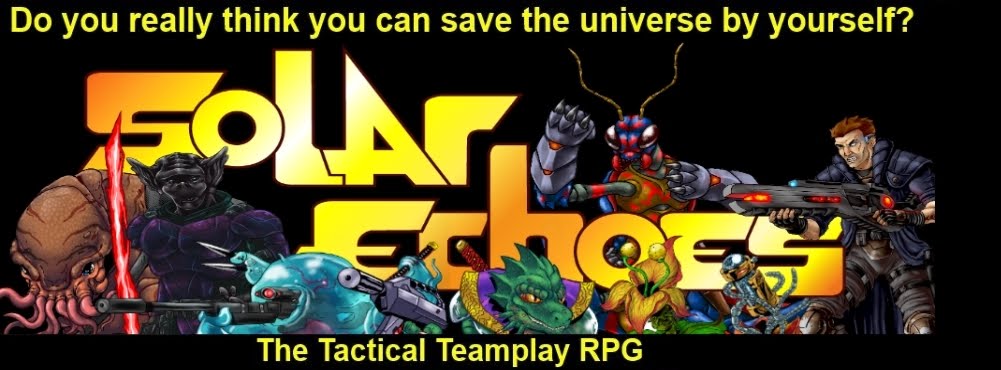
As seven alien races struggle to co-exist in an uneasy alliance, the Inter-Stellar Union sends Union Guard agents on missions to preserve the crucial balance. These specialized operatives must do what regional security cannot, dealing with smugglers, pirates, terrorists, and even greater challenges in order to bring stability to a universe that needs it desperately. Without the Union Guard, the races will not be prepared to face a looming alien threat they can only hope to defeat together.
Thursday, December 31, 2015

Wednesday, December 30, 2015
Resourceful? (part 3)
Another
use of the resourcefulness skill can occur during dialogue
encounters. While one of the characters on the team might be talented
in persuasion attempts, other players can use resourcefulness checks
to find useful information about the target. Success might result in
the discovery of information about him online that could then be fed
to the persuasion-expert on the team, which often results in a bonus
to his persuasion attempts. Resourcefulness might also turn up useful
tips about what keywords the target might be looking to hear. In one
particular mission, a successful resourcefulness check against the
target will reveal that he's only interested in two topics—knowing
this is something only a resourceful character can determine. In
another instance, a successful check will reveal that the confusing
hand motions of a silent prisoner is actually military sign language
to indicate there are listening devices nearby and the characters are
being monitored.
Tuesday, December 29, 2015
Resourceful? (part 2)
I've
seen players use resourcefulness in a number of interesting
situations, and this skill allows players to contribute when they
might otherwise find their character momentarily side-lined (which is
something we really designed Solar Echoes to avoid—we want all
players involved throughout the game!) As an example, in a car chase,
the most active characters are the pilot and the gunner. Characters
may use personal weapons if the pilot manages to close the range on
their target, but at long range, some characters might literally feel
like back-seat drivers. However, with the resourcefulness skill, I've
seen characters in this situation pull out their micro-personal
computers and access road maps for better driving options, or
coordinate driving strategies with agents in other cars. One player
once had the idea to find the municipal traffic control station, and
with a successful resourcefulness check, he succeeded in locating it
online. A successful hack later (involving the other characters in
the back seat) resulted in control of the traffic lights. Needless to
say, that team was able to stop their target from escaping, much more
easily!
Monday, December 28, 2015
Resourceful? (part 1)
If
you've ever watched “Burn Notice,” the character of Michael
Westen is an ingenious burned spy who creatively overcomes many
obstacles and situations through his resourcefulness. In all honesty,
my entire reasoning for the Resourcefulness skill in Solar Echoes was
because of Michael Westen—I wanted the players to be able to do the
kind of stuff he did. The skill at first seems to be very general and
open-ended. However, when players invest a rank in this skill, they
will find it to be quite useful on any mission. At its core,
resourcefulness is the ability to use what you have on hand or to
gain insight into a situation beyond what common sense would normally
avail. Behind the scenes, though, this skill gives the MC (Mission
Controller—the GM in Solar Echoes) an opportunity to drop hints to
the players through a game mechanic. If the team seems unsure of how
to proceed, the MC can simply ask a player with ranks in the skill to
make a resourcefulness check (the MC can set the difficulty to match
the situation.) If the player succeeds, the MC can then give helpful
hints. “You notice...” or “There seems to be...” are examples
of ways to drop the hints in-game. However, the use of this skill
doesn't end there...
Friday, December 25, 2015

Thursday, December 24, 2015
The Star Wars Effect (part 4)
In
2013 at USC, both Steven Spielberg and George Lucas voiced their
prediction: the film industry will soon implode. They foresee a huge
change in the movie-theater experience, with higher-priced tickets
($50 or more), and only the biggest blockbuster movies drawing in
crowds. Considering my own attitude about movie-going, I'll have to
admit that I agree with their predictions. Star Wars may look like
something spurring a massive revival in theater attendance, but it
may actually be the death knell of the movie industry we used to
know. Perhaps our culture has shifted away from the theater
experience, just as digital caused us all to migrate away from
renting Blockbuster Videos. It's easy to imagine a future where the
more thoughtful movies are only available to us online or for
purchase on blu-rays/DVD's. Going to the theater will be reserved for
the kind of family-event that only a movie like Star Wars can manage.
When I saw Star Wars this weekend, a number of audience members were
dressed up as iconic Star Wars characters, including young children,
with many of them wielding toy lightsabers and some even wearing
stormtrooper or darth vader helmets. This is the kind of movie that
will draw all of us out of our homes to see at the theater, and we'll
not only be happy to do it, we'll be ecstatic! I'm probably going to
go see it again!
Wednesday, December 23, 2015
The Star Wars Effect (part 3)
Hollywood
used to hate Star Wars, considering it to be a franchise machine used
to sell toys as much as tickets. Better movies with more substance,
Hollywood moguls insisted, were not receiving their proper attention
when competing with big-budget blockbusters like Star Wars. These
blockbusters were considered forgettable, without critical acclaim,
while the smaller, lesser-known films were those that were awarded
impressive nominations, though these decorated films rarely seemed to
find a very larger audience. This isn't a problem for us, though,
considering that we usually prefer watching the more thoughtful films
at home, paying only a couple dollars to see them. I feel this way
myself—why spend $25-$30 dollars to see a drama that I could just
wait a few months to rent online? There's no hurry, it's not like
everyone is going to be talking about it. I'm only willing to go
through the inconvenience of watching a movie in the theater if it's
an experience that the theater will enhance—I don't need amazing
theater surround sound, 3D projection, and a giant IMAX screen to
watch a thoughtful drama, but I do want those features for a movie
with lots of action and special effects. This shift in attitude
towards movies is one that may affect the industry in a big way...
Subscribe to:
Posts (Atom)